

India’s road infrastructure has changed considerably over the past decade. New highways, wider corridors and access-controlled expressways are reshaping how people and goods move between cities, industrial centres, ports and smaller regional markets.
The scale of this expansion is significant. India’s National Highway network grew from 91,287 km in 2013–14 to 1,46,572 km by March 2026. That represents an increase of more than 55,000 km over the period and reflects the government’s sustained investment in road connectivity.
But the story is not simply about adding kilometres of road. The bigger change is in the type and capacity of infrastructure being built.
Nearly 55,000 Km Added to the National Highway Network
Government data shows that around 54,917 km of National Highways were added between 2014 and 2025. Highway construction has also accelerated during this period.
Construction reached roughly 34 km per day in 2025, compared with about 11.6 km per day in 2013–14.
For the construction sector, this increase represents a substantial pipeline of work covering earthworks, bridges, drainage, pavement construction, structures, safety systems and supporting infrastructure.
At the same time, the focus has shifted toward improving the capacity of existing routes. The length of four-lane and wider National Highways has increased, while the proportion of National Highways with less than two lanes has fallen to around 9% of the overall network.
Expressways Are Changing Long-Distance Travel
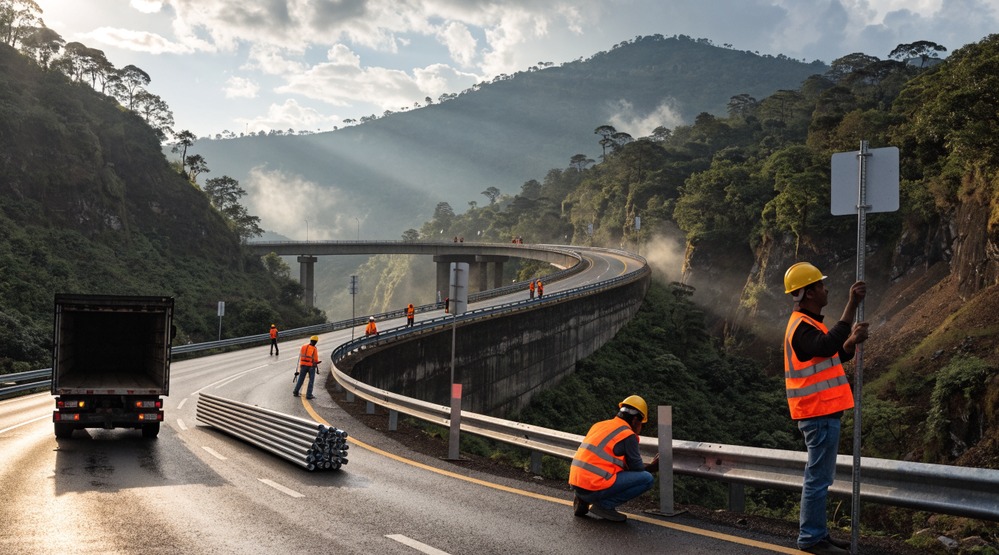
One of the most visible changes has been the rapid expansion of access-controlled expressways and high-speed corridors.
By early 2026, around 3,052 km of access-controlled National High-Speed Corridors and Expressways were operational, compared with just 93 km in 2014.
These roads are being developed to provide faster and more predictable movement between major economic centres. That matters not only to passenger traffic but also to the freight sector.
For logistics companies and manufacturers, more reliable highway connections can affect delivery schedules, vehicle utilisation and the overall movement of goods. For contractors, meanwhile, these large projects involve complex planning across land acquisition, structures, utilities, traffic management and environmental requirements.
Bharatmala Remains a Major Part of the Expansion
The Bharatmala Pariyojana has been one of the major programmes behind India’s highway development push.
According to government figures, around 57,125 km of National Highways were constructed during the five financial years up to 2025, while 21,248 km under Phase-I of Bharatmala had been constructed by September 2025.
The emphasis is also moving beyond the biggest cities. Highway projects are being used to strengthen links to ports, industrial areas, border regions and districts where road connectivity has historically been weaker.
That broader approach is important because better highways can influence more than travel time. They can improve access to markets, support industrial activity and make the movement of construction materials and other goods more efficient.
Maintaining Existing Highways Will Become More Important
Building new highways is only one part of the challenge. As the network becomes larger, maintaining the roads already in service becomes increasingly important.
The National Highways Authority of India (NHAI) is adopting more technology-driven approaches to monitor road conditions and identify maintenance requirements. Predictive asset management can help authorities identify deterioration before relatively small defects develop into expensive repairs.
For a network of this scale, maintenance, road safety and asset management will increasingly need the same attention as new construction.
What Comes Next for India’s Highway Network?
India’s highway expansion is entering a different phase. The emphasis is gradually moving from simply increasing road length toward improving capacity, safety, connectivity and long-term performance.
With the National Highway network now at 1,46,572 km, the next challenge will be ensuring that this infrastructure continues to perform as traffic volumes and freight demand increase.
For contractors, consultants, engineers and infrastructure developers, that means opportunities will extend beyond new road construction. Upgrading existing corridors, maintaining assets, building intelligent transport systems and improving road safety are likely to remain important parts of India’s infrastructure pipeline.
The numbers show how quickly the network has grown. The more important question now is how effectively India can maintain and use that expanding highway system over the long term.